Dog Afraid of People - Where Fear Comes From and How to Help
Fear of people in dogs most often stems from insufficient socialization during the puppy stage or from one or more negative experiences. The most effective approach is desensitization combined with counterconditioning - gradually exposing the dog to people at a safe distance while building positive associations. This takes time and patience; for strong fear or aggression, always consult a certified behaviourist.
A walk that ends with your dog pressed against your legs every time someone passes is hard for both of you. Fear of people is one of the more common behavioural problems in dogs, and it has clear causes. The good news: there is a well-established path forward. The honest part: there is no shortcut.
Where does fear of people come from?
Dogs are not born afraid of people - they learn it, or they learn the opposite. The most important factor is the socialization window, which runs roughly from 3 to 14 weeks of age. During this period a puppy builds its internal map of the world - what is safe, what is neutral. A puppy with limited exposure to different people during this time can grow into an adult dog that finds strangers alarming.
Other common causes:
- A single negative experience - being startled, grabbed suddenly, or frightened by a loud person can create a lasting association of "stranger = danger"
- Genetic predisposition - some dogs are naturally more reactive; this is particularly common in certain breeding lines and in dogs with unknown backgrounds
- Traumatic history - rescue dogs often arrive with fear already built in before they reach their new home
One useful distinction: a dog may fear a specific type of person (children, men, people with hats or walking aids) rather than all strangers. This matters a great deal when planning how to help.
How to recognise fear in your dog
Dogs communicate stress well before they start barking or running. Knowing these signals is fundamental - because you can intervene early, before the situation escalates.
| Stress level | Signals |
|---|---|
| Low | Yawning, lip licking, looking away, blinking, flattened ears |
| Moderate | Lowered posture, tucked tail, backing away, leaning into owner |
| High | Trembling, freezing, attempting to flee, growling, barking |
| Critical | Snapping or biting, full panic, whale eye (whites of eyes visible) |
Early intervention matters most. A dog that regularly passes its fear threshold becomes increasingly sensitised - the trigger grows stronger while tolerance drops. The goal of any behaviour work is to keep the dog comfortably below that threshold.
What NOT to do
Before covering what helps, here are the approaches that are well-intentioned but actively harmful:
- Forcing interaction - "let them pet him, he'll get used to it" is one of the most common mistakes. A dog flooded with the thing it fears learns it cannot escape - which deepens fear or leads to aggression
- Strangers reaching out a hand - the classic "let him sniff your hand" gesture feels polite to humans but is an intrusion into the dog's space by someone it doesn't trust. Ask strangers to stand sideways and ignore the dog instead
- Rewarding during a strong fear reaction - giving a treat when the dog is barking intensely or shaking with fear can reinforce the fearful state
Speaking calmly to your dog ("it's fine, easy now") is neutral and will not make fear worse. The old idea that comfort "rewards fear" is not supported by current behavioural science.
Desensitization and counterconditioning - the core method
The approach that works is a combination of desensitization (introducing the feared stimulus at low intensity, below the fear threshold) and counterconditioning (pairing the presence of people with something the dog genuinely likes, usually food).
The process in plain steps:
- Find the distance at which your dog notices a person but does not react with fear. That might be 30 metres, it might be 100 - it depends on the dog.
- Every time a person appears at that distance, give a high-value treat. Person appears = treat arrives. Person moves away = treat stops. Repeat consistently.
- Decrease the distance very gradually - only once your dog is visibly relaxed at the current distance.
Key rules for the process:
- If your dog reacted with fear, you moved too close. Next time, start from further away.
- Short, frequent sessions (5-15 minutes daily or several times per week) are more effective than long occasional ones.
- Progress is not linear - good days alternate with setbacks. That is normal.
For more on the foundations of socialization and working with distance, see the guide to dog socialization.
Practical tips for walks
Walking a fearful dog calls for a different approach than a standard walk. A few things that make it easier:
- Choose routes with space - parks, side streets, open green areas where you can easily step aside when someone approaches
- Do not apologise for your dog or drag him into contact - if a stranger approaches, simply change direction or step aside and wait for them to pass
- Ask strangers not to touch your dog - "please don't pet him" is completely normal and you owe no further explanation
- Watch your dog, not the approaching person - your attention should be on your dog's stress signals, not on what the stranger is doing
If your dog reacts with aggression (growling, barking, snapping at people), do not minimise it. Fear-based aggression is communication - the dog is saying "stay away." There is more on this in the guide to dog aggression.
When you need a behaviourist
Self-guided work has limits. Consult a certified animal behaviourist when:
- Your dog reacts with aggression (growling, barking, biting) at the sight of people
- Fear is severe enough to make normal walks impossible
- Several weeks of consistent work bring no visible improvement
- You are not confident you are applying the techniques correctly
A good behaviourist will assess the full picture - the dog's history, severity of fear, your own capabilities - and build a plan for the specific case. Look for practitioners who use positive, force-free methods (no punishment, no physical coercion).
A fearful dog deserves the world too
Working with a fearful dog is a long game. But every small step - calmly passing a person at a distance the dog can tolerate - is a genuine win. The dog that hides behind your legs today can, in a few months, watch strangers pass from a distance without reacting at all.
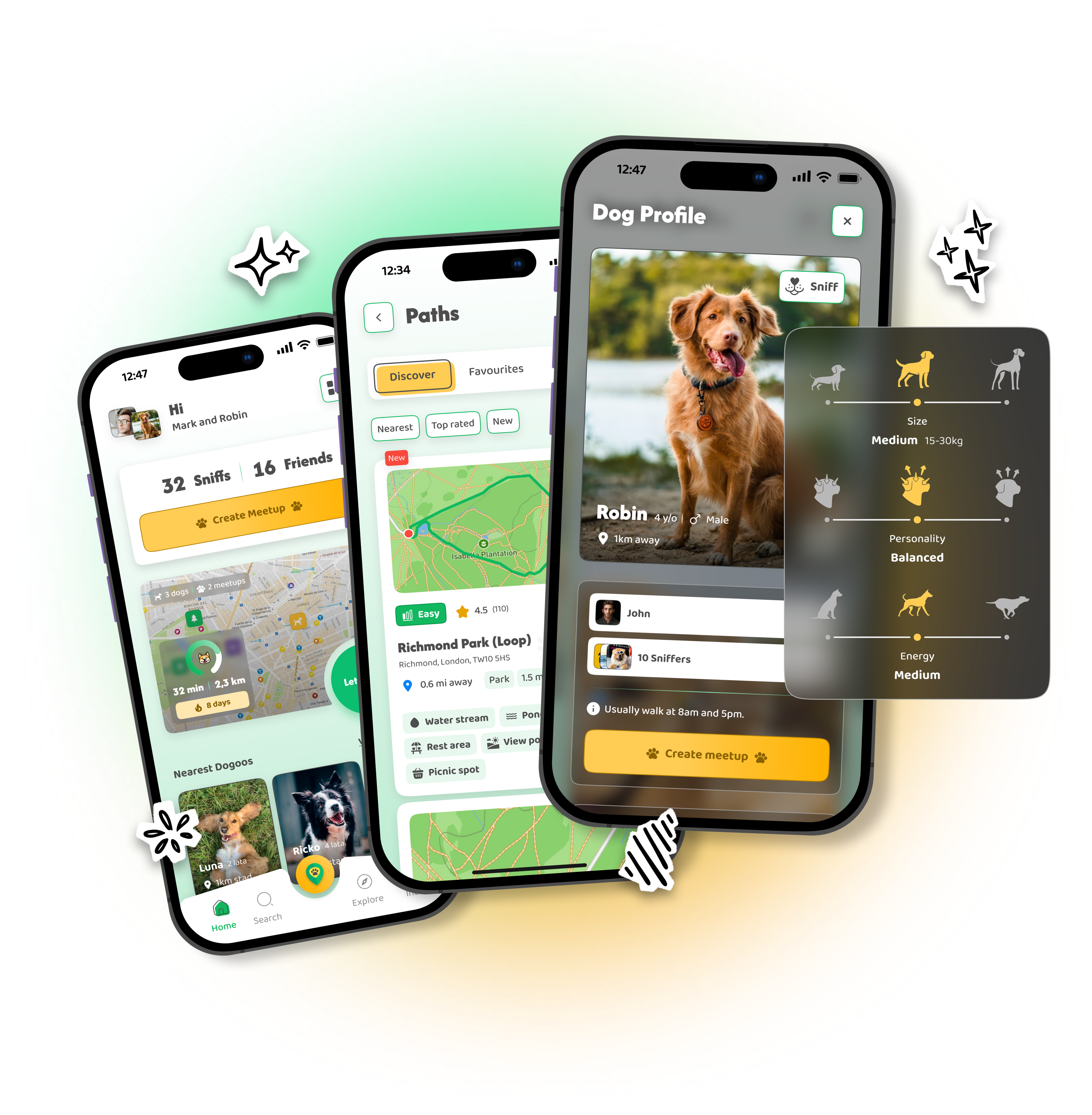
Looking for calm spots where your dog can practise observing people at a comfortable distance? The DOGOUT map shows parks, off-lead areas, and quiet routes tagged by other owners. You can also find walking partners nearby whose dogs have a similar temperament - a controlled introduction to a new person through a shared walk is one of the most natural ways to help a fearful dog take that next step.
Frequently asked questions
- Why is my dog afraid of strangers?
- The most common causes are lack of adequate socialization during the first 14 weeks of life and negative experiences with people - even a single incident can be enough. Some dogs also have a genetic predisposition to fearfulness regardless of upbringing.
- How can I tell if my dog is scared?
- Early signals include yawning, lip licking, looking away, and slight body tension. Stronger fear shows as a lowered posture, tucked tail, backing away, or clinging to you. Whale eye - when the whites of the eyes are visible - is a clear sign of high stress.
- Can a dog be cured of fear of people?
- Full elimination of fear is not always possible, but significant improvement is achievable for most dogs. Systematic desensitization and positive conditioning at the dog's own pace are key. For strong fear or fear-based aggression, working with a behaviourist is essential.
- What definitely does NOT help a scared dog?
- Forcing interaction, letting strangers reach out to pet the dog without consent, and rewarding the dog during a strong fear reaction can all deepen or entrench fear. Speaking to your dog calmly ('it's okay') is neutral and does not make fear worse - the old myth that it 'rewards fear' is not supported by evidence.
- How long does it take to help a dog that fears people?
- It depends on the intensity of the fear and the dog's age and history. Mild fear in younger dogs can improve noticeably within a few weeks of regular work. Deeply rooted fear in an adult dog is often a matter of months. Progress is real - it just does not happen overnight.
- When must I see a behaviourist?
- When your dog reacts with aggression (growling, snapping, biting) at the sight of people, when fear makes normal walks impossible, or when a few weeks of consistent work brings no improvement. A behaviourist will assess the full picture and create a personalised plan.