

Dog and Remote Work - Building a Day That Works for Both of You
Working from home with a dog works best with a steady rhythm: a walk before you start, movement breaks every 2-3 hours, and a clear line between 'I'm available to play' and 'I'm working, don't interrupt.' The two biggest traps are assuming working from home automatically means more walks without actually scheduling them, and a dog learning that barking or pawing at your leg interrupts your work and earns attention. A consistent daily structure solves both faster than instinct ever will.
A dog at your feet while you work from home sounds like a dream - and often it genuinely is. But without a plan, it's easy to fall into one of two traps: a dog that spends the day waiting for attention and learns that interrupting your work pays off, or a dog that, despite your presence in the house, gets less real stimulation than when you used to head into the office. Here's how to build a day that works for both of you.
Why "I'm home" isn't enough on its own
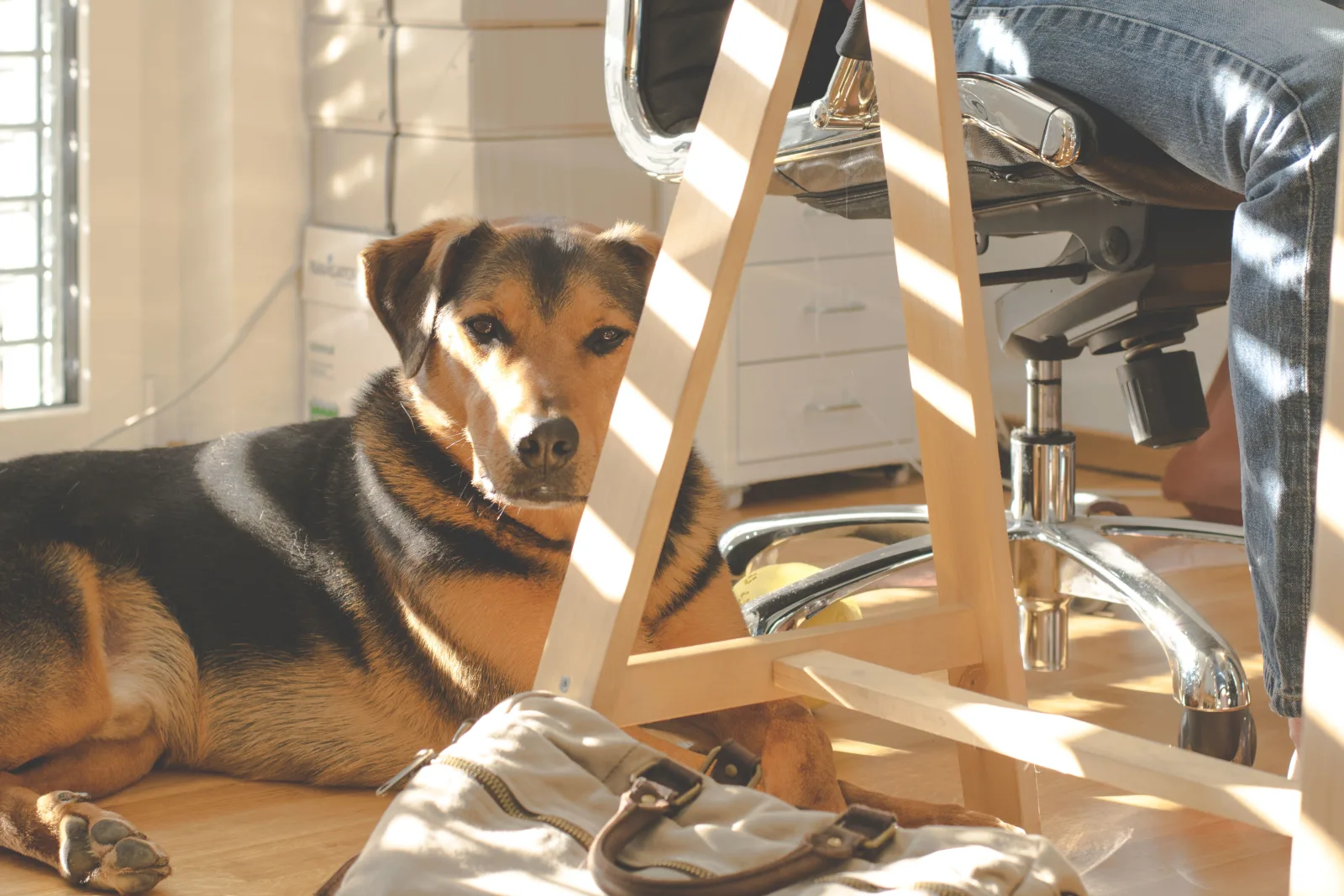
The biggest trap of remote work with a dog is assuming that simply being physically present automatically means a better life for the dog. In practice, if you don't deliberately plan breaks, the dog can spend most of the day lying next to the desk without real movement, sniffing or contact - in other words, potentially more bored than they'd be with a clearly scheduled walk before and after a day at the office.
The key is rhythm, not the number of hours spent physically in the same room. A dog who knows when the walk is coming, when it's playtime, and when to leave you alone copes better than a dog with no structure at all - regardless of how many hours you're technically under the same roof.
A daily frame that works
You don't need to plan the day to the minute, but a repeatable skeleton helps:
- A morning walk before you start work - even 20-30 minutes of movement and sniffing before the first email makes a huge difference to how calmly the dog handles the following hours. A dog that's physically and mentally tired settles more readily.
- Short breaks every 2-3 hours - a trip to the garden, a few minutes of play, topping up water. It doesn't need to be a full walk, just a genuine change of activity.
- A longer walk at lunchtime, if your schedule allows - a natural break in the workday that also resets the dog's energy for the rest of the afternoon.
- A clear "I'm working now" signal - a fixed spot for the dog to lie near the desk, a "go to your place" cue, or simply a closed office door if the dog handles that well.
- A clear "I'm available now" signal - the end of the workday is a good moment for a longer walk or play session, so the dog learns to tell the two states apart.
Teaching a dog to settle near your desk
Not every dog can immediately lie calmly while you work. It's a skill worth training in short sessions:
- Start small - a few minutes, with the dog sitting or lying on a designated spot (mat, bed) near the desk.
- Reward calm lying down, not approaching or demanding attention. Scattering a few treats on the mat helps build a positive association with the spot.
- Gradually extend the duration - from 5 minutes to 20, to an hour, over successive sessions.
- Always end the session before the dog gets restless, not after - this teaches them that calm, not persistence, is what earns the reward.
Chews, snuffle mats or a food-stuffed puzzle toy fill the time between walks nicely and give the dog mental engagement without needing your direct involvement.
When barking and attention-seeking becomes a problem to solve
If your dog barks, scratches at your leg under the desk, or brings you a toy mid-call, ask yourself honestly: are you accidentally rewarding it? Even scolding can register as attention - better than nothing, from the dog's perspective. A practical approach:
- Ignore attention-seeking barking (not to be confused with signalling a real need, like needing to go outside) - don't look, don't respond, don't react until the dog settles, then reward the quiet.
- Make sure needs are met before a work session - a hungry, bored or under-exercised dog is far more likely to demand attention than one who's just had a proper walk.
- Don't punish frustration-driven barking - punishment usually raises stress levels and makes the problem worse over time rather than solving it.
If the problem doesn't improve after a few weeks of consistent work, it's worth consulting a behaviourist - see our guide on choosing a dog behaviourist.
Remote work and separation anxiety - a paradox worth knowing about
Paradoxically, remote work can make it harder for a dog to cope with being alone, if a return to office days or occasional trips suddenly leave the dog alone for many hours without prior conditioning. If you know a change in your work pattern is coming (a return to the office, more frequent trips), it's worth gradually introducing short periods of solitude now, so the change doesn't hit the dog as a sudden shock. More on recognising and preventing separation anxiety in our dedicated guide.
Video calls and meetings - practical tricks
- Schedule a longer walk or play session right before an important call, so the dog is calmer at the key moment.
- Have a chew or snuffle mat ready for call time - a busy mouth means a calmer dog.
- Don't mute the mic in frustration when the dog barks - train ahead of time rather than improvising under stress live on a call.
- Have a plan B - if the dog is having an unusually hard day, a short walk between meetings often solves the problem faster than an hour of fighting for silence.
It pays off for both sides
A well-structured day with a dog during remote work isn't a luxury - it's an investment that pays back in a calmer dog, fewer interrupted meetings, and genuinely better quality time together outside of working hours. Structure doesn't limit freedom - it creates it, because a dog who knows what to expect is calmer than one living in constant uncertainty about the day ahead.
And when that well-earned break arrives, you don't have to go it alone. The DOGOUT map shows who's walking their dog nearby around the same time - a short break from work is a good excuse to swap a solo walk for a meetup with someone from the neighbourhood.
Frequently asked questions
- Is working from home good for a dog?
- Generally yes - more owner presence usually means less time alone and more chances for movement. The problem starts when 'I'm home' doesn't translate into an actual plan of walks and breaks, and the dog ends up lying next to the desk all day without enough real stimulation.
- How do I teach a dog to settle while I work remotely?
- Start with short 'working' sessions with a clear start cue (a specific spot for the dog to lie on, a 'go to your place' command) and reward calm lying down, not approaching the desk. Gradually extend the duration and always end the session before the dog gets restless - that builds a positive association instead of frustration.
- What if my dog barks while I'm working from home?
- Check whether the barking is being rewarded - even a glance or a scolding can register as attention that reinforces the behaviour. Ignore attention-seeking barking (as long as it's not signalling a genuine need, like needing to go out) and reward quiet. If the problem persists, it's worth consulting a behaviourist.
- How many breaks does a dog need during a remote work day?
- As a rough guide, a short movement or bathroom break every 2-3 hours, plus one longer walk in the morning or around lunchtime. The exact number depends on the dog's age, breed and energy level - puppies and high-energy breeds need more frequent, shorter breaks than a calm senior.
- Is it a good idea to leave the dog in another room during video calls?
- It can help, if the dog has a comfortable, familiar spot there and something engaging (like a snuffle mat or a chew), rather than it feeling like a punishment or isolation from the rest of the home. For dogs with separation anxiety, even a closed door in the same flat can be stressful - watch the dog's reaction rather than assuming it will be fine.