Dog Body Language - How to Read What Your Dog Is Really Saying
Dogs communicate primarily through their bodies - tail, ears, gaze, muscle tension and posture. A wagging tail does not always mean happiness: height and stiffness matter. Calming signals (yawning, nose licking, head turns) indicate discomfort. Reading dog body language as a whole - not one signal in isolation - helps you prevent conflict and understand your dog's real needs.
Your dog never stops talking. Every muscle twitch, every tail position, every glance away is a sentence. The problem is that most owners only notice barking or silence - and miss everything in between. Dog body language is a complete language. Time to learn it.
Why reading your dog's body language matters
Understanding canine signals is not a nice-to-have - it is a practical skill that can literally prevent a bite. Dogs rarely attack without warning: they typically signal discomfort through many body language cues before escalating. Owners who can read those signals can step in earlier, before the situation tips.
The same applies to dog socialisation - a dog that reads other dogs well and is read well by its owner handles new situations much more confidently.
Golden rule: read the whole body, not one signal. Tail, ears, eyes, muscle tension, posture - these elements must be read together. A wagging tail on a stiff body is completely different from a wagging tail on a loose, relaxed frame.
The tail - more than just happiness
Tail wagging is one of the most misread signals in dogs. Not all wagging means joy.
| Tail position | What it may mean |
|---|---|
| High, stiff, fast short wags | Arousal, tension, readiness to confront |
| Mid-height, relaxed wag | Calm, friendly interest |
| Full body wiggle (helicopter tail) | Strong joy, close bond with the person |
| Low, tucked between legs | Fear, insecurity, strong stress |
| Held horizontal, still | Attention, focus, assessing the situation |
One important note: compare your dog's tail position to its neutral baseline. Some breeds naturally carry their tail high; others carry it low. Context is everything.
Ears - the emotional radar
A dog's ears reveal emotional state almost instantly - they react faster than the rest of the body.
- Ears forward - alertness, interest, focus on something specific.
- Ears relaxed, slightly to the sides - calm, comfortable.
- Ears pressed flat against the head - fear, uncertainty, submission, or strong arousal. For floppy-eared breeds (Labradors, Spaniels, Beagles), watch the movement at the base of the ear rather than the ear tip.
Eyes - the window into your dog's emotions
Soft eyes with slightly squinted lids signal calm and comfort. The dog's gaze is loose and relaxed.
Hard stare - fixed, intense, with tension around the eyes - is a warning signal. The dog is guarding something or feels threatened.
Whale eye appears when the dog turns its head away but keeps its eyes on the source of discomfort - the whites of the eyes become visible in a crescent shape. This is a serious signal that the dog is extremely uncomfortable. Do not ignore it.
Calming signals - the language of de-escalation
Calming signals is a term coined by Norwegian dog trainer and behaviourist Turid Rugaas, who identified over 20 behaviours that dogs use to defuse tension in themselves and others.
The most common calming signals:
- Yawning with no sign of tiredness - often triggered when someone leans over the dog, raises their voice, or approaches face-to-face
- Nose licking - quick, subtle - easy to miss, but dogs never miss it in each other
- Head or body turn - the dog literally turns away from the source of tension
- Slowing down - when someone calls the dog excitedly or impatiently, the dog slows to a crawl
- Sniffing the ground - the dog sniffs at the ground at the exact moment a stressful event occurs
- Freezing - a brief, complete stop in motion
- Play bow - front legs bent down, rear end up - an invitation to play, and also a calming signal in uncertain situations
When you see these signals in your dog, the situation is stressing it. Respond: give it space, change the subject, or remove the source of discomfort.
Stress signals that need a response
Beyond calming signals, some stress indicators point to a higher level of distress:
- Heavy panting without physical exertion
- Trembling or shaking
- Wet paw prints on the floor (dogs sweat through their paw pads when stressed)
- Raised hackles (piloerection) along the spine or at a specific point
- Ears flat, tail tucked
- Frantic, unfocused behaviour
A dog in strong stress cannot learn. Training in that state is ineffective and may make the problem worse. This matters a lot when teaching recall or any other skill - if your dog looks frantic, end the session.
Play vs. conflict - how to tell them apart
Dogs rough-housing can look alarming. It is not always a problem. Here is what to look for:
| Feature | Play | Conflict / aggression |
|---|---|---|
| Body tension | Loose, bouncy, exaggerated | Stiff, rigid |
| Role swap | Both dogs take turns chasing / being chased | One dog dominates throughout |
| Breaks | Regular pauses to reset | No breaks |
| Sounds | Higher-pitched, short barks | Low, sustained growling |
| Re-engagement | Both dogs bounce back eagerly | One dog tries to leave or freezes |
Trust your gut and do not hesitate to pause play if something looks off. A short break lets you see whether both dogs genuinely want to continue.
Growling - a signal to respect
A growl means: "I am uncomfortable, I need more space." A dog that growls is giving you a chance to prevent escalation. Never punish a dog for growling. Punishment removes the warning without removing the discomfort - and a dog that has been punished for growling may next time skip straight to a bite with no warning at all.
If your dog growls frequently, it is a sign it regularly ends up in situations beyond its comfort threshold. A consultation with a qualified behaviourist is worthwhile - and also check whether loose-leash walking situations are part of what triggers it.
Putting it all together - whole-body reading
Dog body language is the sum of all signals at once:
- Crouching, cowering, avoiding eye contact - fear, submission
- Standing tall, stiff, direct stare, high tail - arousal, confrontational readiness
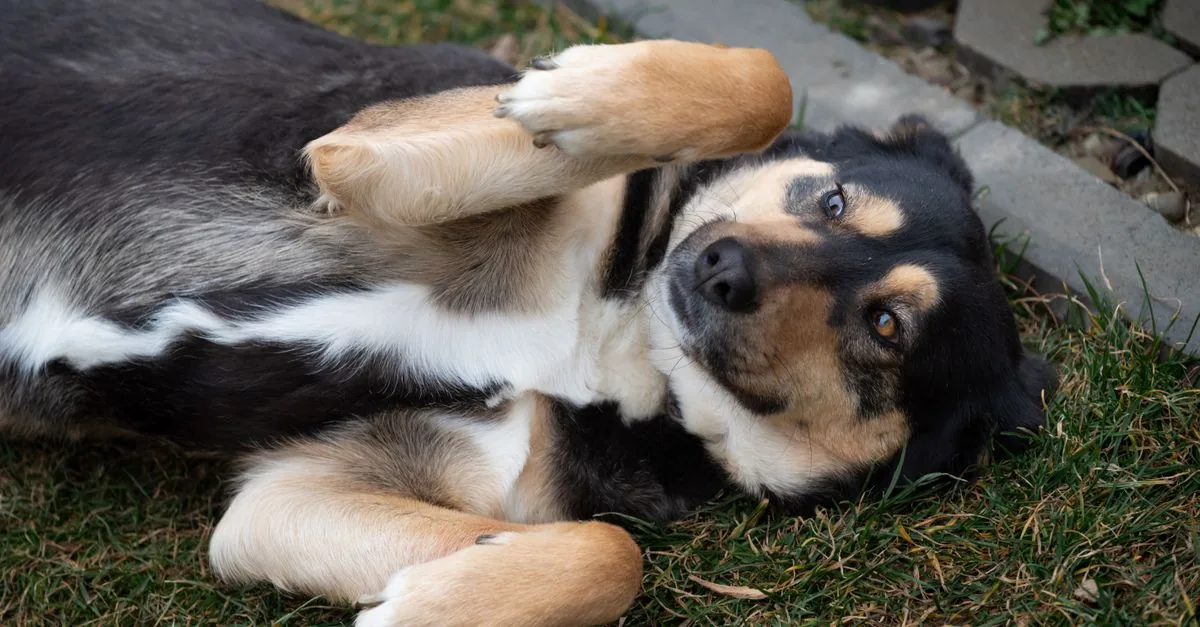
- Rolling onto back and showing belly - can be an invitation to pet (loose body) or strong stress (tense body, tucked tail) - read the rest of the body carefully
- Head resting on paws, soft upward gaze - seeking contact, relaxed
Learning to read your dog's body language changes every walk, every park visit, every greeting. You start to see when your dog is ready to play and when it needs a wider arc around that stranger on the bench. Open the DOGOUT map to find off-lead areas, parks and trails near you - great places to watch your dog be a dog and practise reading it in the real world.
Frequently asked questions
- Does a wagging tail always mean a happy dog?
- No. A tail held high and wagging stiffly signals arousal or tension, not joy. A happy tail wags freely at a mid or slightly low position - often with the whole back end. A tail tucked between the legs signals fear or strong stress.
- What are calming signals in dogs?
- A term introduced by Norwegian behaviourist Turid Rugaas. These are behaviours dogs use to defuse tension - their own or others'. They include yawning, nose licking, head turning, slow movement, sniffing the ground, freezing, and the play bow. Seeing these signals means something is stressing your dog.
- What does whale eye mean in dogs?
- Whale eye refers to the white of the eye (sclera) becoming visible in a crescent shape when the dog turns its head away but keeps its gaze fixed on a perceived threat. It is a significant warning sign that the dog is very uncomfortable. Give the dog space and do not approach with your face.
- Should I punish my dog for growling?
- Never. Growling is a warning signal - the dog is telling you it has reached its limit. Punishing a growl removes the warning without removing the discomfort. A dog that has been punished for growling may skip the warning next time and bite without any prior signal.
- How do I tell the difference between play and aggression between dogs?
- During play, bodies are loose and movements exaggerated and 'clumsy'; dogs take turns chasing and swap roles regularly. In conflict, bodies stiffen, there are no breaks or role reversals, and low growling appears. Play can look loud and chaotic - but dogs visibly relax between sequences and willingly re-engage.
- Why does my dog yawn when I pet it?
- Yawning during petting is often a calming signal - the dog is telling you it is uncomfortable, for example with hugging around the shoulders, leaning over it, or overly intense contact. It is not boredom - it is a request for lighter touch or a brief pause.