Easy Dog Tricks - Step by Step for Every Dog
Dogs of any age can learn simple tricks using positive reinforcement - reward with a treat within 1-2 seconds of the correct behaviour. Start with shake or spin, practise for 3-5 minutes a few times a day, and always end the session before your dog gets tired. Tricks provide mental stimulation and strengthen your bond.
Teaching tricks is one of the easiest ways to build a real bond with your dog and give it something that daily life often lacks - a genuine mental challenge. Five minutes of active thinking during a training session will tire a dog more than twenty minutes of a low-key on-lead walk. Here is how to get started.
Why bother teaching tricks?
Tricks are not just entertainment. Training with positive reinforcement:
- strengthens your bond - your dog learns that focusing on you pays off
- reduces stress - active thinking lowers cortisol levels and calms dogs that tend to be restless
- builds a foundation for more serious commands - a dog that can shake hands picks up loose-leash walking and recall faster
- prevents boredom - boredom is the root cause of furniture chewing, excessive barking, and digging
One caveat: tricks complement walks, they do not replace them. Pair indoor training with outdoor time and you have a recipe for a well-balanced dog.
How does positive reinforcement work?
The principle is straightforward: reward the behaviour you want to see more of. No punishment, no "dominance", no making the dog wait to build respect. A dog that gets rewarded for the right response is happy to repeat it next time.
The critical detail is timing. The reward must reach your dog within 1-2 seconds of the correct behaviour. Any longer and your dog cannot connect the treat to the action. This is where a clicker or a marker word ("yes!") helps - you mark the exact moment, then calmly reach for the treat.
How to structure a training session
- Duration: 3-5 minutes per session, 2-4 sessions per day
- Location: start in a quiet room, no children, no other pets, no TV in the background
- Treats: small, soft pieces - sausage, cheese, chicken (dry kibble alone rarely motivates enough)
- Ending: always finish before your dog gets bored - ideally end on a successful repetition
5 easy tricks step by step
1. Shake (paw)
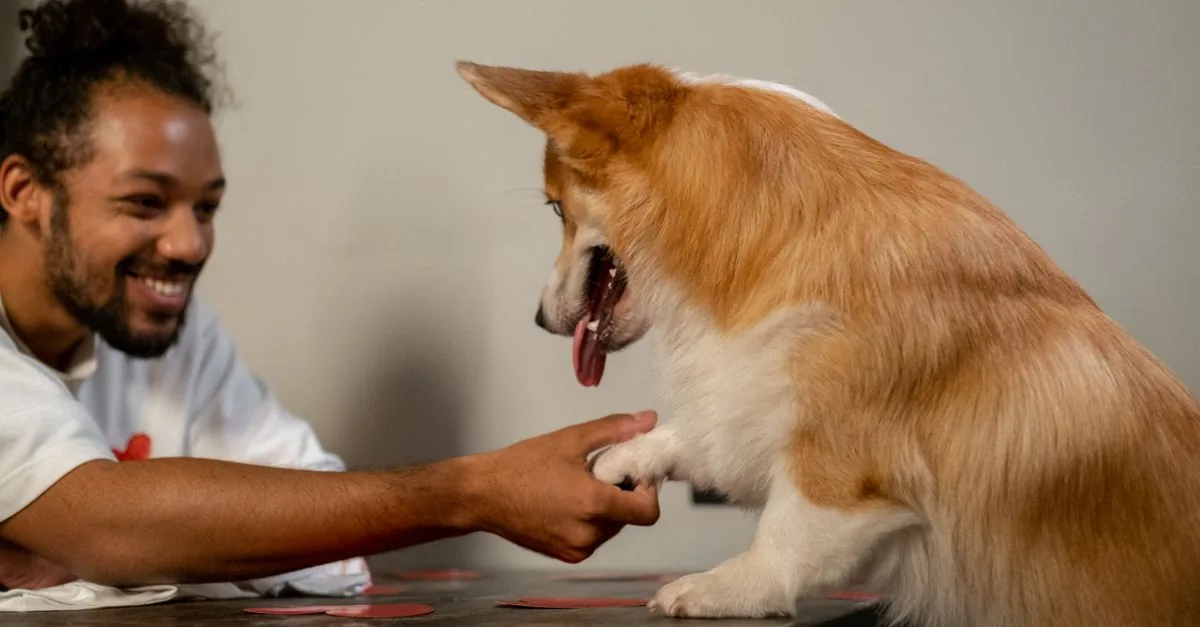
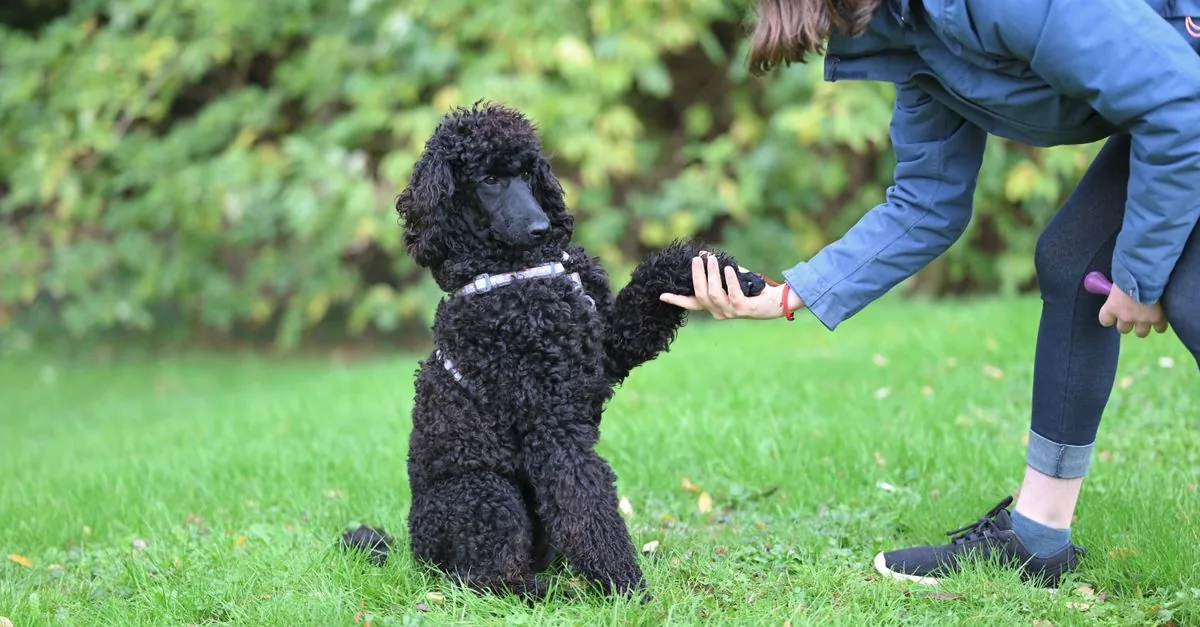
The classic starter - most dogs discover this almost by accident while learning to sit.
- Ask your dog to sit.
- Hold a treat in your closed fist at paw height.
- Your dog will sniff and paw at your hand - wait for it to touch your fist with its paw.
- The moment it does, mark ("yes!") and open your hand.
- Once your dog does this reliably, add the cue "shake" just before the movement.
For a full step-by-step guide, see the teach dog to shake paw article.
2. Spin
An impressive trick that dogs pick up surprisingly fast.
- Stand in front of your dog, hold a treat at nose level.
- Slowly guide your hand in a full circle - your dog follows its nose and completes the loop.
- The moment it finishes the circle, mark and reward.
- Repeat 5-8 times, then gradually reduce the hand movement until a small gesture is enough.
- Once the gesture works reliably, add the cue "spin" or "around".
3. Bow
Dogs do this naturally during play - you just need to capture the movement and name it.
- Stand in front of your dog.
- Hold a treat at its nose and guide it down and back, between its front paws.
- The moment its elbows touch the floor (with its rear still raised), mark and reward immediately.
- If your dog lies flat, place your other hand gently under its belly to keep the back end up.
- Once the movement is reliable, add the cue "bow".
4. Touch (nose targeting)
The foundation for many tricks and a great tool for teaching focus.
- Hold your open palm in front of your dog, fingers pointing down.
- When your dog sniffs and touches your hand with its nose, mark and reward.
- Repeat, gradually moving your hand further away - to the side, up, down.
- Add the cue "touch" or "target".
5. Stay - basic version
Impulse control is useful in every situation. Technically a command rather than a trick, but it starts exactly the same way.
- Ask your dog to sit.
- Say "stay" and take one step back.
- Return to your dog after 1-2 seconds and reward - do not call the dog to you.
- Increase the time and distance very gradually.
For a detailed guide and more advanced proofing, see the teach dog to stay article.
Tricks compared - difficulty and learning time
| Trick | Difficulty | Typical time to learn |
|---|---|---|
| Shake (paw) | very easy | 1-3 sessions |
| Touch (nose target) | very easy | 1-3 sessions |
| Spin | easy | 3-7 sessions |
| Bow | easy | 3-7 sessions |
| Stay (short duration) | medium | 1-2 weeks |
| Fetch | medium | several weeks |
These are rough guides - every dog learns at its own pace. Older dogs may need more repetitions than puppies, but they get there just as reliably.
Common mistakes when teaching tricks
Sessions that go on too long. Your dog starts making mistakes and getting frustrated - that is the signal to stop. End on a success, not a failure.
Raising the difficulty too fast. If your dog learnt "spin" in a quiet living room and you immediately try it in a busy park, that is several steps too many. New environment means going back to basics.
Poor treat timing. Your dog does not know what earned the reward. Work on your marker timing - a clicker makes this significantly easier.
Repeating the cue multiple times. "Shake, shake, come on, shake!" teaches your dog to ignore the first few repetitions. Say the cue once, wait 3-5 seconds, and if there is no response, reset and try again with luring.
A dog that knows a few tricks is a dog you actually want to take outside. When you do go out, use the DOGOUT map to find off-lead areas and dog-friendly spots nearby - great places to practise with your dog in the fresh air, and maybe find a training buddy along the way.
Frequently asked questions
- What age can I start teaching my dog tricks?
- Puppies can start learning simple tricks from around 8-10 weeks old. Keep sessions very short - 1-2 minutes - and use only positive reinforcement. Older dogs learn just as effectively; they may simply need a few more repetitions.
- How long should trick training sessions be?
- Aim for 3-5 minutes per session, repeated 2-4 times a day. That adds up to roughly 10-15 minutes of daily training. Short, frequent sessions are far more effective than one long session where your dog loses focus or becomes frustrated.
- What treats should I use for trick training?
- Use small, soft treats your dog can swallow quickly - small pieces of sausage, cheese, or cooked chicken work well. The reward must arrive within 1-2 seconds of the correct behaviour so your dog connects it to the right action.
- Do tricks replace walks?
- No. Tricks provide valuable mental stimulation and can genuinely tire a dog out mentally, but they do not replace physical exercise. Combining regular walks with short training sessions at home gives the best results for your dog's overall wellbeing.
- My dog won't focus during training - what am I doing wrong?
- The session is probably too long, the treats not exciting enough, or the environment too distracting. Try cutting the session to 2 minutes, upgrading to a higher-value treat, and training in a quiet room. If your dog loses focus, simply end the session - never punish a lack of attention.
- Do I need a clicker for trick training?
- A clicker is useful but not essential. You can replace it with a short marker word like 'yes!' spoken at the exact moment of the correct behaviour. What matters is consistency - always use the same marker and deliver it instantly, before you reach for the treat.