How to Make Dog Walks Better: Escape the Same-Loop Routine
The quickest fix is to stop leading and let your dog lead. A slow sniff-at-everything walk gives a dog more mental stimulation than a brisk 5 km on a tight leash. Add new routes, short training moments, and the occasional meetup with other dogs - and your dog will sleep better, behave better, and ask for more.
Same patch of pavement. Same five lampposts. Same bored dog who trots two metres ahead and then stares at you expecting something more. Sound familiar? The problem isn't a lack of time - it's a lack of variety. Dogs aren't built for routine. They're built for novelty, information, and the occasional burst of chaos. Here's how to give them that.
Let the dog lead - the sniffari
A sniffari is exactly what it sounds like: a walk where your dog calls the shots. You follow. It stops, you stop. It pulls left toward a drainpipe, you go left. No destination. No brisk pace. No "come on, we don't have all day."
Why does it work? A dog's nose processes roughly 100,000 times more scent information than a human's. Every patch of grass is a news feed. A pee-mail from the labrador who passed at 7am. A fox that cut through at midnight. A dropped sandwich crust from three days ago. Reading all that takes work - serious mental work. A 20-minute sniffari tires a dog out more than an hour of fast walking on a short lead. It also reduces anxiety, lowers cortisol, and genuinely satisfies a dog's need to process its environment.
The rule: let the dog sniff for as long as it wants before moving on. Drop the tension in the lead. Breathe.
New routes and environments - novelty is enrichment
Even swapping the direction of your usual loop gives your dog a brand-new olfactory experience. But go further than that. City blocks, forest paths, riverbanks, gravel car parks, market squares on a Tuesday morning - each surface, each ecosystem carries a different smell profile. To your dog, a pine forest and a scrubby urban park are as different as a seafood restaurant and a bakery.
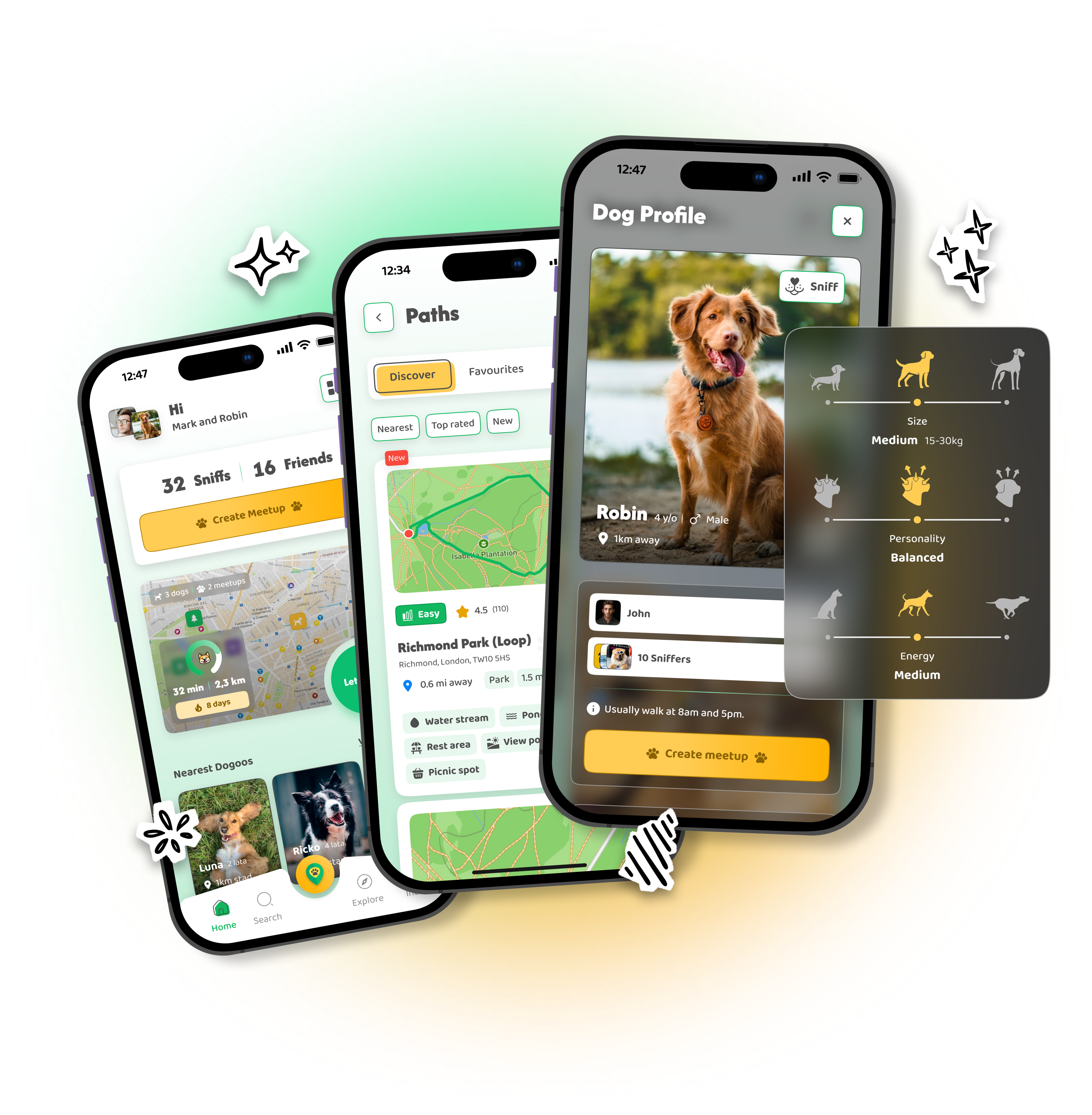
Make it a habit: one genuinely new environment per week. Not a detour of 50 metres - a different neighbourhood, a different park, a different type of ground under the paws. Find the best options on the DOGOUT map, which shows dog-friendly parks, trails and spots tagged by other owners. If you're based in Warsaw, see the guide to dog parks in Warsaw for where dogs can legally run off-leash, district by district.
Match the environment to the dog
A high-energy working breed burns through a city park in 10 minutes and needs something bigger. A nervous rescue might find a crowded urban space overstimulating and do better on a quiet forest path. Observe how your dog moves and where it's most relaxed - then give it more of that.
Short training bursts during walks
You don't need a training session at home to keep a dog's mind sharp. Pull out a treat mid-walk and ask for a sit, a down, a heel for 30 seconds, or a recall from five metres. Keep each burst under a minute. End on a success. Reward generously.
Training during a walk works better than training at home for two reasons: distractions are real (which raises the difficulty and the value of the reward), and the dog is already switched on and engaged with the environment. A dog that works its brain on a walk is a dog that comes home and lies down.
Key skills to practice outdoors: recall (the most important - see our guide to how many walks a dog needs for context on exercise and behaviour), loose-leash walking, sit and stay with distractions, calm greetings with strangers. All of these get sharper in the real world, not just the living room.
Meetups - other dogs change everything
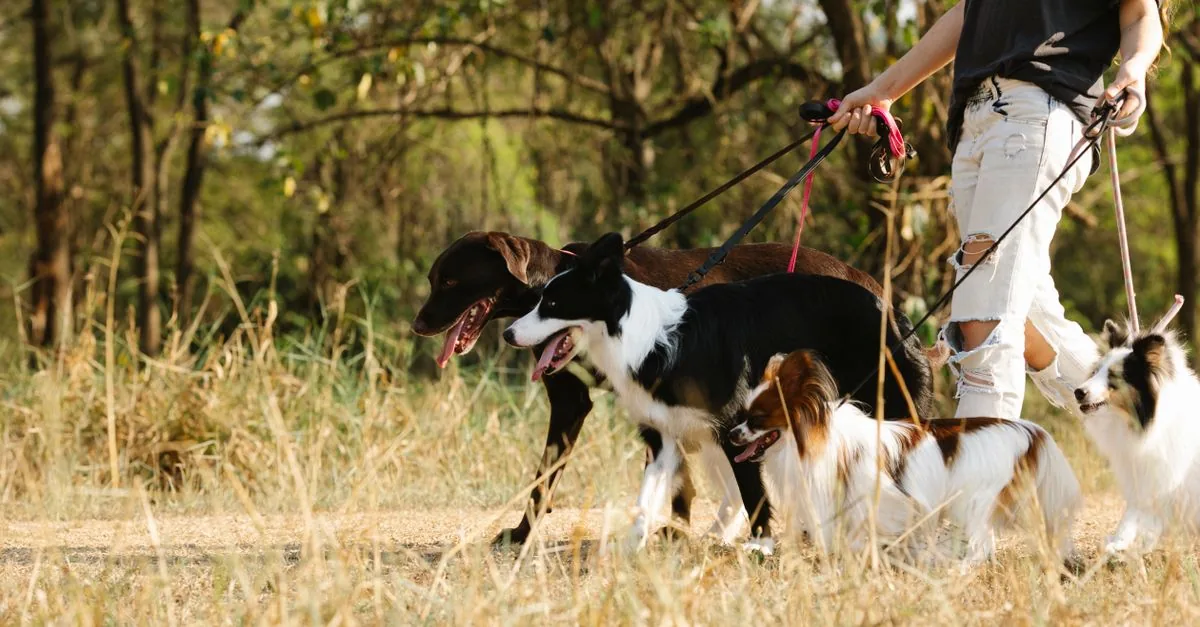
For most dogs, another dog is the best thing that can happen on a walk. The sniffing, the play, the posturing, the chase - it fires up every sense at once. A solo walk becomes a social event.
Spontaneous meetups happen when you cover new ground. Planned ones are even better: you know the other dog is safe, the owner is on the same page, and you can let them off-lead somewhere sensible.
DOGOUT makes this easy. You can see who's out walking nearby in real time, join a walk in progress, or post a meetup in your area. One tap and a solo loop turns into a group outing. It's the fastest way to turn a good walk into a great one.
Water, mud and nature
If your dog is a water dog - or even just a dog - a river, lake or muddy puddle is peak walk experience. Let it in. Carry a towel. The car will survive. What you get in return: a dog that has actually used its body, explored its senses and done something genuinely exciting rather than completing another lap of the block.
Rivers, lakes and beach walks also introduce completely different smells and sounds - water birds, fish, algae, reeds, wet sand - that a city dog almost never encounters. Novelty is enrichment. See our guide on running with your dog if you want to take water and trail walks to the next level.
Same walk vs enriched walk - what your dog actually experiences
| What the dog gets | Same route every day | Varied, enriched walk |
|---|---|---|
| Smell information | Mostly familiar, few surprises | Rich, novel, constantly changing |
| Mental load | Low - it knows what's coming | High - new data to process |
| Stress relief | Minimal | Strong - sniffing lowers cortisol |
| Physical fatigue | Moderate (distance only) | Moderate to high (body + brain) |
| Social stimulation | Usually none | Possible meetups, new encounters |
| Behaviour at home after | Often still restless | Usually calm and settled |
| Excitement level | Routine, low engagement | Engaged from the first step |
The same loop every day isn't a walk - it's a chore you both have to get through. A varied, enriched walk is the difference between a dog that comes home and flops down satisfied and a dog that barks at the wall two hours later.
Start with the smallest change: drop the lead tension, follow the nose, and let five minutes stretch to ten. Then find a new patch of ground. Then message another owner and go together. The DOGOUT map has the places and the people - all you have to do is go further than usual.
Frequently asked questions
- What is a sniffari?
- A sniffari is a walk where you let your dog set the pace and direction - it sniffs whatever it wants, for as long as it wants, and you follow. No fixed route, no rushing. The term plays on 'safari': your dog is hunting information through its nose.
- Why does sniffing tire a dog out?
- A dog's nose is exponentially more powerful than ours, and processing scent information is intense cognitive work. Research and practical experience both show that 20 minutes of active sniffing can exhaust a dog more than an hour of fast walking.
- How often should I change my dog's walk route?
- As often as you can manage. Even swapping your usual loop for a different direction gives your dog a new set of smells. Aim for at least one genuinely new environment per week - different surface, different smells, different sounds.
- Can I do training on a walk?
- Yes, and it works really well. Short 30-second bursts of recall, heel, or sit practice during a walk add mental load without extending the time you're out. Keep it playful and reward generously.
- How do I find other dog owners to walk with?
- DOGOUT lets you see who's out walking nearby in real time and join a walk or organise a meetup in a tap. It's the fastest way to turn a solo loop into a social outing.
- Is a calm slow walk better than a fast one?
- For mental enrichment, yes. A loose-leash sniff walk is far more tiring and satisfying for most dogs than the same distance on a short lead at your pace. Physical and mental exercise each serve different needs - ideally a dog gets both.