Road Salt and Dog Paws - How to Protect, Wash and When to Worry
De-icing salt and chemical ice melts irritate paw pads, and packed into the gaps between the toes they cause stinging and small splits. The bigger problem starts when a dog licks them off: calcium chloride can irritate the mouth and gut, and a larger dose of ice melt disturbs the electrolyte balance. Protection is simple and effective: petroleum jelly or paw wax before you go out, routes that avoid gritted pavements, and a thorough rinse in lukewarm water with the spaces between the toes dried afterwards.
From the first frost, city pavements turn into grey salted slush that your dog walks through for the better part of an hour every day. In summer we watch out for hot asphalt burning paw pads. The winter version is less dramatic because it works slowly, but it runs for four months rather than a handful of hot afternoons.
The good news is that protection is cheap and takes two minutes before you leave and two after you get back. The bad news is that most people start thinking about it only once the dog begins to limp.
What salt actually does to paws
Pavements are usually gritted with sodium chloride, ordinary road salt, and less often with calcium or magnesium chloride, which work at lower temperatures. All of them affect paws in similar ways, with different intensity.
Irritation and drying. Salt draws water out of the skin. Paw pads, already more prone to cracking in winter, become rough and vulnerable to small splits. Calcium chloride is harsher than plain salt and with prolonged contact can cause chemical irritation.
Packing between the toes. This usually hurts more than contact with the pad itself. A mixture of salt, grit and ice compacts into hard lumps in the gaps between the toes and rubs the thin, sensitive skin there with every step. Long-haired dogs with dense fur between the toes have the worst of it.
Salt on an existing graze. If your dog already has a split or scrape on a pad, salt stings exactly as you would expect.
The bigger risk: licking
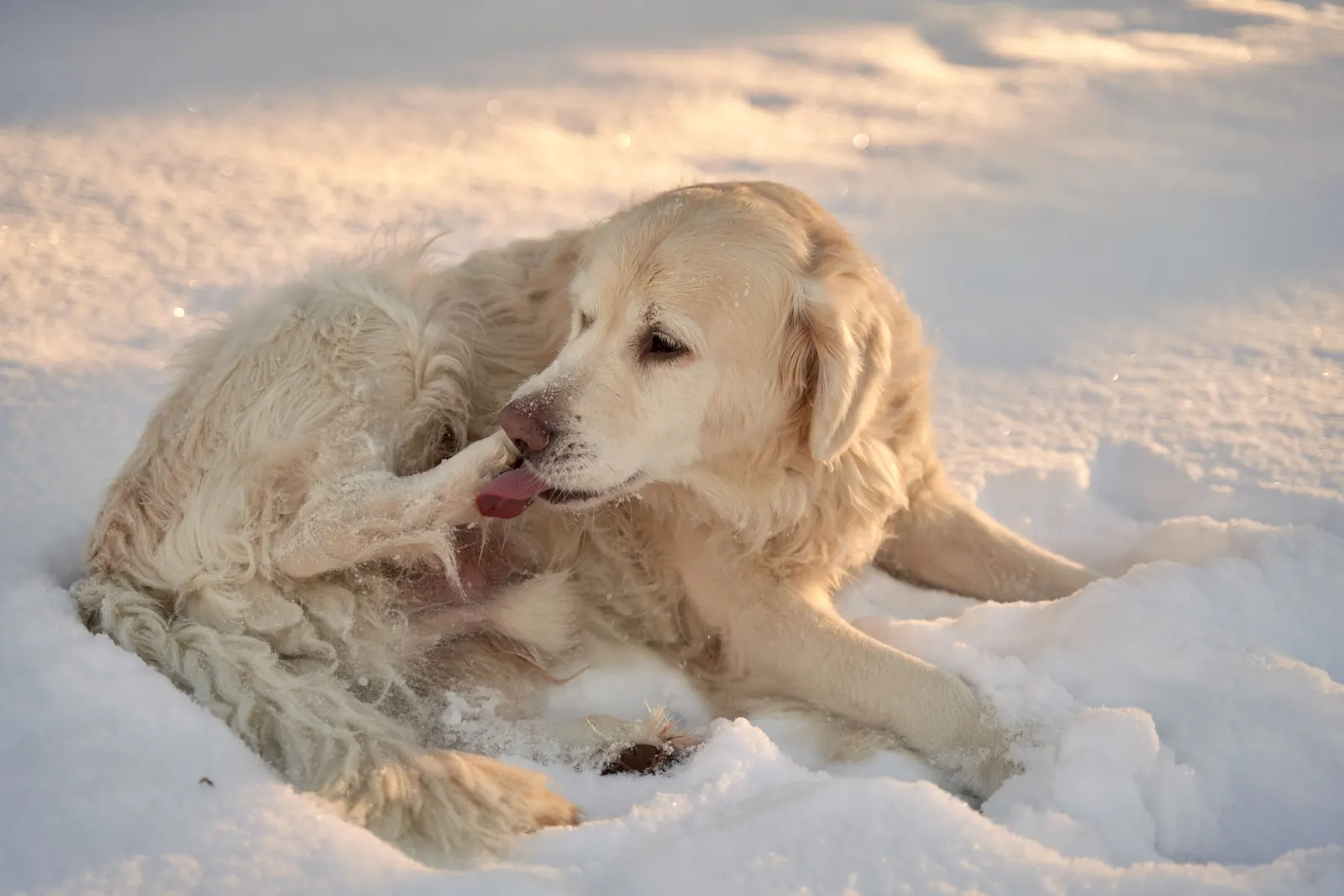
A dog bothered by something on its foot does one thing: it licks. That is the point at which this stops being a skin problem.
A few licks of salty slush usually does nothing serious, at worst an upset stomach. The problem begins with larger quantities, particularly when a dog eats granules straight off the pavement or from a spilled bag. Calcium chloride can irritate the lining of the mouth and digestive tract, and excess salt disturbs the electrolyte balance: vomiting, diarrhoea, heavy thirst, lethargy, an unsteady gait and, in severe cases, muscle tremors and seizures.
Serious poisoning is rare and generally requires eating a real quantity of the product rather than just licking paws clean. But rare is not the same as impossible, and the most exposed are puppies and small dogs, for whom the same amount weighs proportionally far more.
Go to the vet immediately if your dog has eaten ice-melt granules, is vomiting, has diarrhoea, is drinking noticeably more than usual, is weak, unsteady or trembling. Take the product packaging with you if you have it, because the composition matters for treatment.
Two minutes before you leave
Petroleum jelly or paw wax. A thin layer on the pads and between the toes before you go out creates a barrier that limits salt contact and makes it harder for ice to stick. It takes seconds, costs very little and works. Wax lasts longer than petroleum jelly, but petroleum jelly is in every pharmacy.
Trim the fur between the toes. On dogs with heavily furred feet, keeping the hair between the pads short reduces the ice balls that build up along the way. Do not shave down to bare skin, which also protects against cold.
Boots. For a dog that walks gritted city pavements every day, boots are the most effective answer because they remove the problem at source. The condition is that the dog gets used to them in advance, indoors and on short outings. A first fitting on a freezing evening tends to end with a dog frozen in place, refusing to take a step.
The route matters more than the products
The simplest protection involves nothing you apply, only where you walk. Councils grit pavements, crossings and driveways. They do not grit parks, grass, forest paths or riverside walks.
A winter route that skips the centre and runs through green space removes the salt problem almost entirely, and gives your dog a better walk into the bargain: more scent, softer ground, fewer people. If the options near you are not obvious, it is worth looking at the DOGOUT map, where the places are added by guardians themselves, so the less obvious parks and paths show up too.
In practice a mixed pattern works best: brief toilet trips near the building, and the main walk of the day moved onto green space.
Washing that actually achieves something
These are the most important two minutes of the whole winter.
- Rinse the paws in lukewarm water. Not hot. Cold pads react to hot water with pain, and rapid warming does the skin no favours. A bowl by the door is plenty; a shower is easier with a larger dog.
- Rinse between the toes. This is where most of the salt lodges and where irritation starts. Spread the toes and flush the gaps, and check the skin around the nails too.
- Dry them. Moisture trapped between the toes encourages irritation and infection on its own. A towel is enough.
- Look at the pads. Ten seconds. Redness, cracks, grazes, anything lodged in them. The sooner you spot it, the less of it there will be.
If washing in a bowl is a nightly battle, it is worth spending a few evenings calmly getting your dog used to having its feet handled. It is a skill that pays off at the vet and during nail trims too. We go into it further in the piece on cleaning paws after a muddy walk.
Signs not to ignore
| Sign | What it probably means | What to do |
|---|---|---|
| Licking paws more than usual | Salt irritation or residue between the toes | Wash, inspect, apply petroleum jelly before the next walk |
| Stopping mid-walk, lifting a paw | Ice balls between the toes, or stinging | Clear the lumps, cut the walk short, switch to green space |
| Redness, cracked skin along pad edges | Drying and chronic irritation | Paw balm, reduce salt exposure |
| Wounds, swelling, clear pain on touch | Damage that needs assessing | Vet |
| Limping that persists after rest | May have nothing to do with salt | Vet, see the piece on lameness |
| Vomiting, diarrhoea, weakness, tremors after a walk | Possible ingestion of ice melt | Vet urgently, take the packaging |
Two other winter hazards
Antifreeze. Ethylene glycol tastes sweet, dogs readily lick it from puddles under cars, and even a small amount threatens the kidneys. This is a more serious risk than salt. Avoid puddles in car parks and under vehicles, especially brightly coloured ones, and treat any suspected contact as a veterinary emergency.
Frozen water. Ice on a pond or river looks the same whether it is five centimetres thick or five millimetres. A dog let off the lead near water in winter is a risk you cannot take back. Keep the lead on anywhere it could get onto the ice.
Four months, two minutes a day
Winter paw care needs no equipment and no specialist knowledge. Petroleum jelly before you leave, a route through green space instead of a gritted pavement, and a rinse on the way back deal with essentially the whole problem. The rest is making sure your dog does not eat anything off the ground, which is harder in winter because you cannot see what is under the snow.
Check the DOGOUT map for a way through your area that avoids the salted slush, and see who else is out at a similar time. In winter an arranged walk has an extra advantage: it is much harder to talk yourself out of.
Sources
Frequently asked questions
- Is road salt dangerous for dogs?
- On its own it rarely causes serious poisoning, but it regularly irritates paw pads and the skin between the toes, where it can cause stinging and small cracks. The real risk comes from licking: a few licks of salty slush usually amounts to nothing worse than an upset stomach, while a larger quantity of ice melt can disturb the electrolyte balance and cause vomiting, diarrhoea, lethargy and, in severe cases, muscle tremors.
- How should I wash my dog's paws after a winter walk?
- Rinse them in lukewarm water, not hot, because cold paw pads react to heat with pain. A bowl by the door is enough. What matters most is rinsing thoroughly between the toes and around the nails, because that is where most of the salt lodges. Then dry with a towel, since moisture left between the toes encourages irritation in its own right.
- Does petroleum jelly protect a dog's paws from salt?
- Yes. A thin layer of petroleum jelly or a purpose-made paw wax applied before you leave creates a barrier that limits contact with the skin and makes it harder for ice to stick between the toes. It is a stopgap, not a replacement for washing afterwards: the protective layer collects the salt, which still has to come off.
- Are dog boots a good idea for winter?
- For dogs that walk a lot on gritted city pavements they are the most effective protection there is. There is one condition: the dog has to get used to them beforehand, indoors and on short walks. Putting boots on for the first time on a freezing evening usually ends with a dog that refuses to move.
- How can I tell salt has irritated my dog's paws?
- The dog licks its paws more than usual, limps or stops mid-walk, lifts a paw, and once home you can see redness, grazes or cracked skin between the toes and along the edges of the pads. If there are open wounds, swelling, clear pain on touch, or the dog will not put weight on the foot, it needs a vet.
- What if my dog eats road salt?
- After a few licks, offering water and watching is usually enough. If your dog has eaten a quantity of ice-melt granules, or if it vomits, has diarrhoea, drinks heavily, becomes weak, unsteady or starts trembling, go to the vet straight away and take the product packaging if you have it. The exact composition matters for treatment.