

Dog Agility: How to Start, and What Not to Do
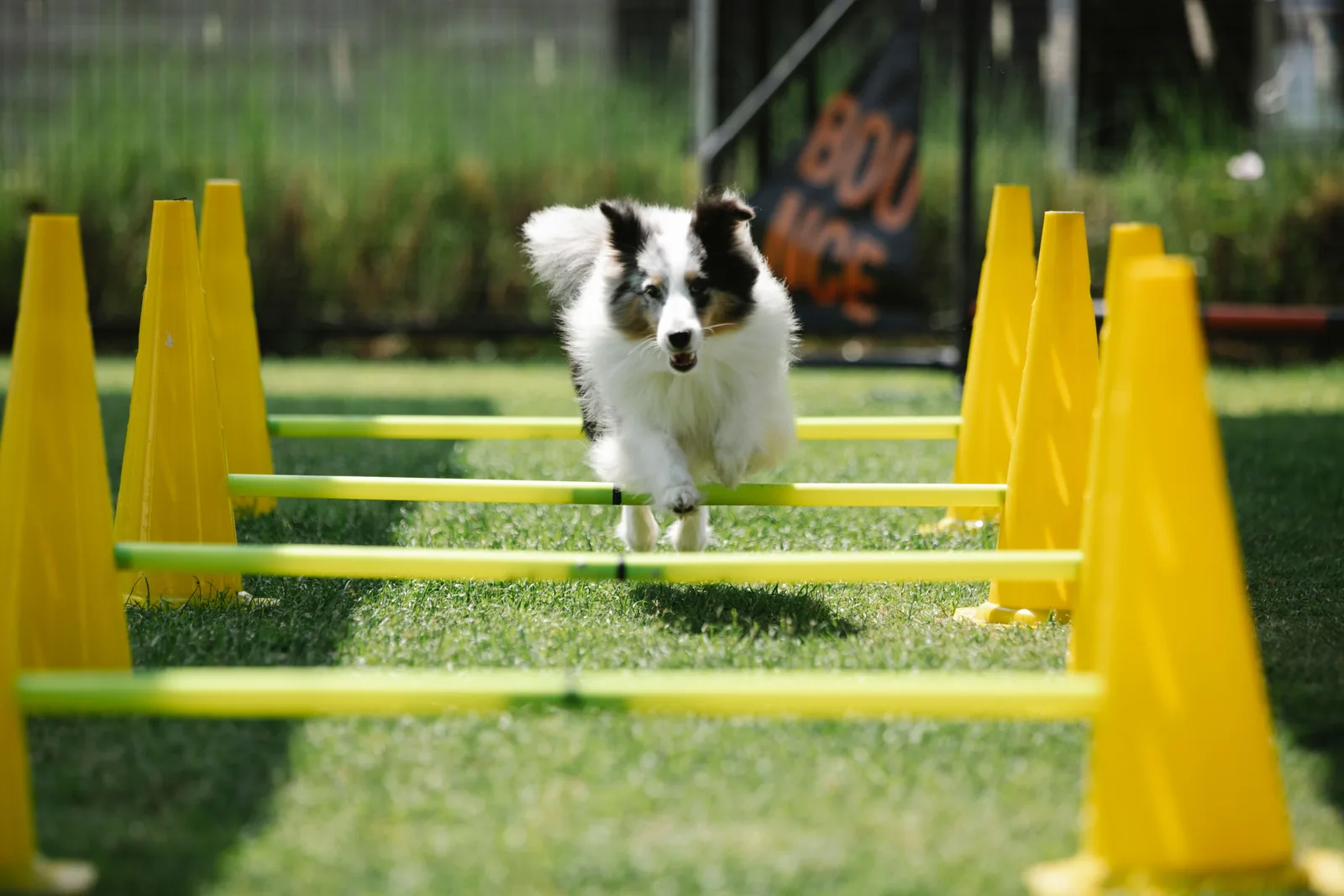
Agility is an obstacle course the dog runs on its handler's cues. Foundation work - focus, body awareness, tunnels and flat work - can start at almost any age. Full-height jumps and contact obstacles only after the growth plates close: a little after 6 months in small dogs, closer to 18 months in giant breeds, always confirmed by your vet. Get an orthopaedic check before the first class and never start without a warm-up.
Online, agility looks like a game: the dog tears through a tunnel, hits the weaves, lands past a jump, the crowd cheers. At training it looks different, because it is first and foremost a sport, and in sport the order in which you introduce things is what counts. Done well, agility gives a dog movement, contact with its handler and weeks of mental work. Done badly, it ends in a front-limb injury.
What agility is, and what it is not
Agility means running a course of obstacles in a set order, purely on the handler's cues - voice, body movement and position. The dog does not know the route; it reads you. That makes it as much the handler's sport as the dog's, and the pairs that progress fastest are usually the ones who sorted out communication first, not the ones who got to full jump height soonest.
What agility is not:
- It is not a way of burning a dog's energy by running alone. A dog tired out by running without mental work often comes home more wound up.
- It is not a playground you can just walk into and let the dog loose. Contact obstacles without taught technique are a risk.
- It is not a sport only for herding breeds. Mixed breeds and rescue dogs compete successfully; what decides it is health and willingness to work, not pedigree.
What age to start
This is the single most important decision here, because the mistake is irreversible. Growth plates, the growth zones in the long bones, are sensitive to overload and, once damaged, lead to developmental abnormalities and pain. VCA states plainly that long jogs, jumping hurdles and competing in agility should wait until the dog is mature.
| Dog size | When the growth plates usually close | What you can do before then |
|---|---|---|
| Small breeds | a little after 6 months | Flat work, tunnel, pole on the ground, body awareness |
| Medium breeds | typically between 9 and 12 months | The same plus very low obstacles, after asking your vet |
| Large breeds | around 12-18 months | Flat work and focus; no jumping |
| Giant breeds | closer to 18 months, sometimes longer | Flat work and focus; no jumping |
The exact point is confirmed by a vet, not by a calendar. You are not losing time in the meantime: AKC guidance is to introduce a puppy to agility with jump heights set very low or with bars on the ground, on puppy-sized foundation equipment, with the emphasis on flat work and focus exercises. That is the foundation that later decides how fast you can go.
What the injury data says
The numbers are worth knowing, because they let you train deliberately rather than on instinct. In a Finnish study of 864 dogs at competition level:
- 14 percent of dogs were injured over the course of a year,
- the competition injury rate was 1.44 injuries per 1000 runs,
- the front limb was injured in 60.5 percent of cases, followed by the back (19.3 percent), the brachium (16.0 percent) and the scapular region (13.4 percent),
- among obstacle-related injuries, bar jumps dominated at 36.5 percent, then the dogwalk (17.5 percent) and the A-frame (15.9 percent),
- more than two agility sessions a week was associated with higher injury risk,
- dogs with multiple previous agility injuries had far higher odds of another one.
Three practical conclusions follow: jump and contact-exit technique matters more than anything else, more training is not better, and a dog returns to the course only after it is fully healed and cleared by a vet.
A health check before the first class
Before you sign your dog up, go through this with your vet:
- joints and spine - hips and elbows in particular; we covered what hip dysplasia in dogs looks like and why it matters separately,
- body weight - excess weight increases the load on every landing,
- heart and fitness in older dogs,
- eyesight, because the dog reads both the course and your cues at a distance.
An existing orthopaedic diagnosis does not automatically mean no exercise. It means a conversation with your vet and a physiotherapist about which elements are off the table and what can be done in a low-impact version.
The obstacles explained
| Obstacle | What it involves | Note |
|---|---|---|
| Tunnel | The dog runs through a soft tunnel | Easiest to introduce, a good starting point |
| Bar jumps | Jumps over bars at adjustable heights | Largest share of injuries; raise the height gradually |
| Weave poles | The dog weaves between upright poles | Technically hard, loads the spine if the pattern is wrong |
| Dogwalk | A narrow raised plank with ramps | A contact obstacle, needs an instructor |
| A-frame | Two ramps set up in an A shape | A contact obstacle; the descent technique is critical |
| Seesaw | A pivoting plank that tips under the dog | Requires getting used to moving ground |
| Table or pause zone | A stopping point on the course | Teaches self-control under arousal |
How to start with no equipment and no club
The first weeks can be done on a field or in your living room with nothing but treats and a few household objects:
- Flat work. The dog holds position at your side, speeds up and slows with you, changes direction off your shoulder. This is the foundation of the whole sport.
- Cone wraps. A plant pot, a rucksack, a tree. The dog circles an object on a cue from a distance.
- Pole on the ground. Stepping and trotting over a stick lying on the grass. Builds the pattern with zero jumping load.
- Body awareness. Placing paws on a low stable platform, backing up, repositioning the hind feet. A badly underrated element.
- Focus under arousal. Eye contact and a response to the dog's name while something interesting is going on nearby.
- Tunnel, if you have a children's play tunnel. Short, straight, reward on the far side.
Most of these are easiest to introduce with a marker; we covered the basics in clicker training for beginners. It also helps to be able to read your dog, so you can tell tiredness from discouragement - we go through the signals in dog body language.
What not to build yourself: the dogwalk, A-frame and seesaw. An unstable homemade structure plus untaught descent technique is the shortest route to a front-limb injury.
Warm-up and cool-down
A dog that steps out of the car and straight onto the course is working on cold muscles. The warm-up need not be complicated: 5-10 minutes of walking, then a few minutes of trotting, a few direction changes, a few easy cone wraps, and only then obstacles. Afterwards, the same in reverse: a few minutes of calm walking to bring the heart rate down.
What not to do
- Do not raise jump height because "the dog jumps higher than that on walks anyway".
- Do not train on slippery floors or on wet, frozen grass.
- Do not do more than two agility sessions a week when you are starting out.
- Do not repeat the same run over and over to make it come off.
- Do not return to the course after an injury without veterinary clearance.
- Do not force a dog that refuses an obstacle; a refusal is information, not disobedience.
Where to train in autumn and winter
This is a good moment to start, because the indoor season is beginning and clubs are opening new beginner groups. An indoor hall has one real advantage over an outdoor field: stable, non-slip footing regardless of the weather, which matters a great deal while technique is being learned.
Look for a club running instructor-led beginner classes, ideally in small groups. Rates vary a lot between cities and formats, so check prices locally. If there is no club nearby, work on the foundation and consider sports with a lower barrier to entry: nosework or canicross, neither of which needs a course or a hall.
Agility rewards patience: communication first, then technique, speed last. Get your dog checked, start with flat work and a tunnel, find a club with an instructor. And for routes, rest days and people to walk with, check the DOGOUT map - the best canine athletes are still the dogs that walk a lot.
Sources
Frequently asked questions
- What age can a dog start agility?
- Foundation work without jumps or contact obstacles can start with a puppy: focus, flat work, tunnels, body awareness. Full-height jumps and contacts only after the growth plates close, which happens a little after 6 months in small dogs and closer to 18 months in giant breeds. VCA advises waiting until maturity before jumping hurdles or competing, and your vet can tell you when that point has arrived.
- Is agility safe for dogs?
- It is a sport, so it is not risk-free, but the risk can be managed. In a Finnish study of 864 competition-level agility dogs, 14 percent were injured over the course of a year, and the competition injury rate was 1.44 injuries per 1000 runs. What matters most is introducing obstacles gradually, warming up, keeping the dog lean and not overloading the training week.
- Is my dog suited to agility?
- Agility is not reserved for border collies. What you need is a dog that is orthopaedically sound, at a healthy weight, willing to work with you and keen to move. Joint and spinal problems, heart conditions and excess weight are the main contraindications, as is very heavy body mass where jumping is involved. Get a veterinary check before you start.
- Which obstacle causes the most injuries?
- In the Finnish study, bar jumps were involved most often, accounting for 36.5 percent of obstacle-related cases, followed by the dogwalk (17.5 percent) and the A-frame (15.9 percent). The front limb was the most commonly injured area, in 60.5 percent of cases. That is an argument for teaching technique and raising the bar slowly, not for avoiding the sport.
- Can I train agility without a club?
- The foundations, yes, and they are the right place to start: flat work, cone wraps, stepping over a pole lying on the ground, a tunnel improvised from a children's play tunnel, body-awareness exercises. Do not build or teach contact obstacles - dogwalk, A-frame and seesaw - on your own, because a technical error on an unstable homemade structure is how dogs get hurt.
- Will agility tire out a hyperactive dog?
- Physically yes, but running a course does not by itself teach calmness, and in some dogs it raises arousal. The real value of agility for such a dog is that it demands cooperation, waiting for a cue and self-control between runs. If hyperactivity is the main problem, add scent work and impulse-control training rather than sport alone.