Dog Paw Boots: When They're Actually Necessary
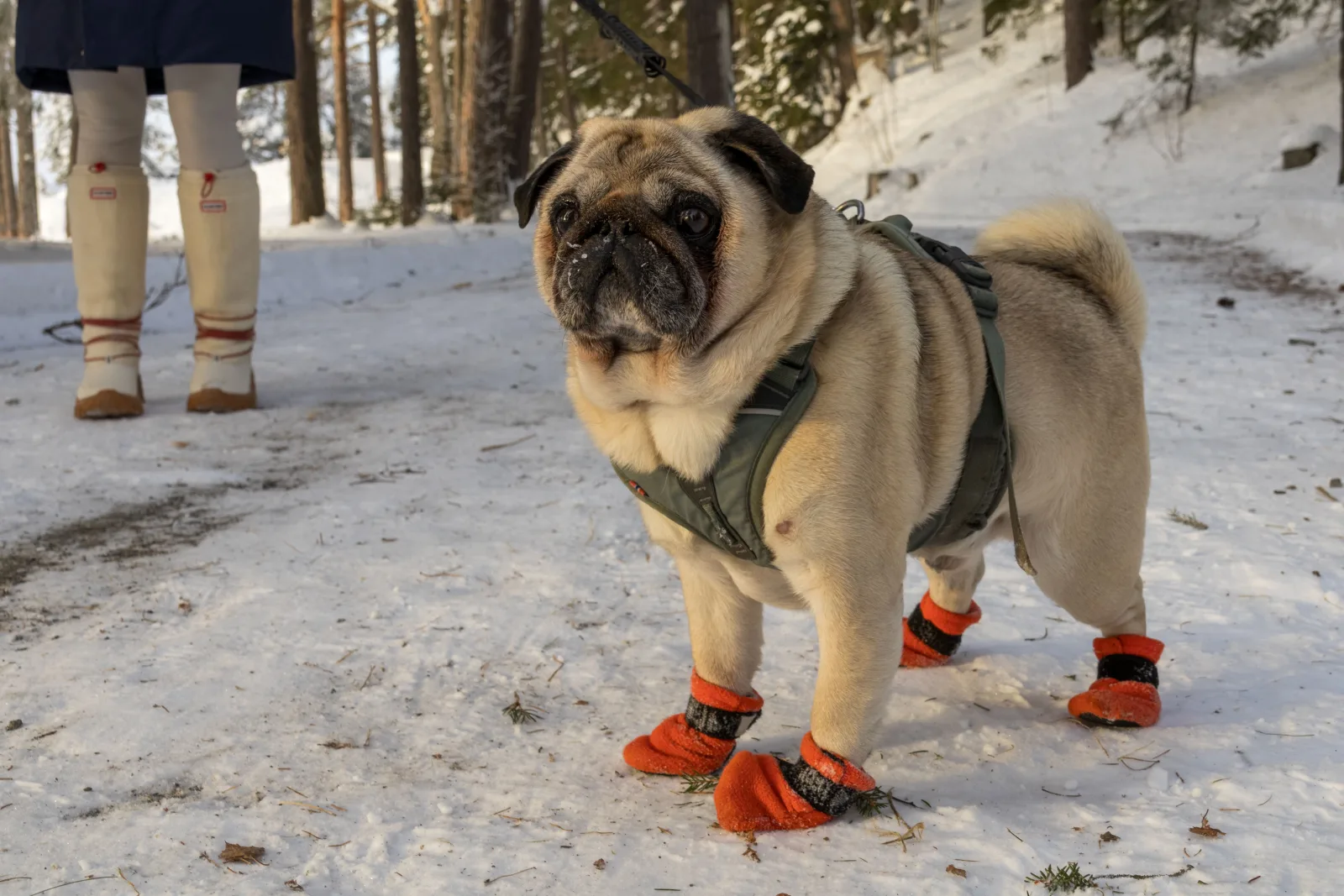
Paw boots earn their place in three situations: summer, on hot asphalt that can burn paw pads, winter, on salted pavements where salt irritates the skin between the toes, and rough, rocky terrain where cuts are easy to pick up. Outside those situations, most dogs manage fine without boots, a protective balm and avoiding the hottest or saltiest surfaces is usually enough. The biggest challenge is rarely the purchase itself but getting your dog used to walking in them, plan for a few days of patient practice.
Dog paws are tougher than they look, but they have limits, summer-hot asphalt, winter-salted pavements and sharp stones on a trail can all cause real damage. Paw boots are not a must for every walk, but in specific conditions they make a genuine difference.
When paw boots actually make sense
Summer, on hot surfaces. Asphalt and concrete in full sun heat up far more than the surrounding air, they can reach a temperature that burns paw pads within seconds of contact. The simplest test: press the back of your hand to the surface for 7 seconds, if you cannot stand it, your dog should not be walking on it afterwards either.
Winter, on salted pavements. Salt and other de-icing agents dry out the skin between the toes, causing irritation and, with extended contact, cracking. An added problem: dogs often lick their paws after a walk, swallowing whatever chemicals have collected on them.
Rough or unstable terrain. Rocky mountain trails, broken glass in the city, sharp branches after a storm, in these conditions boots protect against cuts you cannot predict in advance.
Outside these situations, most healthy dogs do not need boots for everyday walks. Regular, moderate walks on normal ground actually toughen up the paw pads over time.
The alternative - protective balm
If boots feel like overkill, or your dog flatly refuses them, protective paw balm is a reasonable middle ground. It moisturises and creates a thin protective barrier on the pads, which helps with moderately warm surfaces or brief salt contact. It will not replace physical protection in extreme heat or on rough terrain though, it is a supplement, not a substitute for boots in tough conditions.
How to size boots correctly
Poorly sized boots do more harm than good, too tight restricts blood circulation, too loose falls off at the first energetic stride and ends up lost in the mud.
- Stand your dog on a flat surface in a natural, relaxed stance.
- Trace the paw outline on paper (or measure width and length with callipers).
- Measure each paw separately, front and back paws are often different sizes.
- Compare the result against the specific manufacturer's size chart, not a generic "S/M/L."
Sole material and closure - what to look for beyond size
Size is only half the job, the rest depends on the sole material and closure system matching where you actually walk.
Width matters as much as length. Trace the paw while your dog stands in a natural stance, fully weight-bearing, a paw under load spreads wider than one lifted in the air. A boot sized only to toe length, without accounting for the widest point of the paw, will pinch at the sides and rub with every step.
Dogs with thick fur between the toes (Nordic breeds, long-haired shepherds) often need half a size up from what the paw outline alone would suggest, the fur takes up real space inside the boot. The alternative is trimming the fur between the pads before the first fitting, so the measurement is accurate.
Rubber soles grip well on ice but wear down faster on asphalt with regular city walks. Tougher, reinforced soles hold up on rocky mountain terrain but are stiffer and heavier for everyday use. For ordinary city walks, a medium-firm, all-purpose sole is enough.
Velcro closures go on faster but loosen over a longer, more active walk and need checking partway through the route. Drawstring or strap closures that tighten above the ankle hold more securely on a longer route but take more time to put on. Fit at the ankle joint matters here, that's exactly where the boot needs to grip snugly so it doesn't slip off mid-stride, even if the rest of the fit is spot on.
For older dogs or dogs with joint issues, also look for low boot weight and a soft, flexible upper, a stiff, heavy boot makes an already uncertain gait harder, not easier.
Getting a dog used to boots
This is usually the bigger challenge, not the purchase itself. Dogs have no natural experience with anything on their paws, so the first reaction is often a stiff, high-stepping gait, shaking a paw, or trying to pull the boots off with their teeth. That is normal and improves with patient training:
- Day 1-2 - show the boots, let your dog sniff them, reward just for being near them.
- Day 3-4 - put one boot on for a few minutes at home, in a calm setting, with plenty of treats.
- Day 5-6 - put all four on, stay at home, watch the gait, it should gradually normalise.
- Day 7+ - the first short walk in boots, on a familiar, quiet route.
Do not put boots on for the first time right before a long walk or in a stressful situation, that is the surest way to make your dog associate them with something negative.
Table - boots or balm
| Situation | Recommendation |
|---|---|
| Short walk, moderate temperature | Protective balm is enough |
| Hot asphalt in summer | Boots, or shift the walk to cooler hours |
| Salted pavements in winter | Boots, or thoroughly rinse paws after the walk |
| Rough, rocky terrain | Boots strongly recommended |
| A wound or cut healing | Boots to protect a dressing |
Common mistakes
- Buying boots based on weight alone, without measuring. Manufacturer sizing is based on paw dimensions, not body weight, two dogs of the same weight can have very different paw sizes.
- Giving up after the first failed attempt. Most dogs react badly to boots the first time, that doesn't mean the model is wrong, it usually just means the habituation process needs more time and patience.
- Putting a boot on just one paw "because the dog protests less." An uneven gait can be worse than no boots at all, if you're going with boots, use the full set unless it's temporary protection for one specific wound.
- Ignoring worn fastenings. Velcro and straps wear out over time, a boot that falls off halfway through a walk protects nothing and risks getting lost on the trail.
- Boots too loose, so the dog just shakes them off within minutes. If a boot comes off at the first trot, the problem is almost always sizing or an undertightened strap at the ankle, not the idea of boots itself.
- Skipping the acclimation process entirely and heading straight into a long walk. A dog that has never worn boots before might just sit down, refuse to move, or fall over trying to shake them off, that doesn't mean the boots are wrong, it means steps 1 through 6 from the section above got skipped.
- The wrong sole for the terrain, a smooth sole on ice for instance. This one backfires, a smooth rubber sole on ice can actually be more slippery than bare paw pads, which have their own natural grip.
- Not checking for rubbing after longer wear. After the first few longer walks in new boots, check the skin between the toes and around the edge of the upper, redness or chafing means the size or cut needs adjusting before you head out for another long stretch.
What it costs
Basic sets of dog paw boots typically cost a few dozen zloty for a set of four. Models with a tougher sole built for rocky mountain terrain, or better fastening systems, cost more. Protective paw balm is a distinctly cheaper option, roughly ten to a few dozen zloty for a tub that lasts many weeks of regular use.
Instead of boots - change the time of day
Sometimes the simplest fix is not buying anything, just shifting the walk to a cooler time, early morning or evening in summer, once the pavement has had time to cool. We cover walking safely with a dog in hot weather in more depth in our guide on how to cool down a dog.
Find a better route instead of better boots
Sometimes the issue is not your dog's paws, it's the route. A hot pavement along a busy road can often be swapped for a shaded park path or a forest trail, where surface temperature is many degrees lower. On the DOGOUT map you will see places tagged by other owners nearby, sometimes a better route is a cheaper and more effective fix than any piece of protective gear.
Frequently asked questions
- How can I tell if the pavement is too hot for my dog's paws?
- Press the back of your hand to the surface and hold it there for 7 seconds, if you cannot last that long, it is definitely too hot for your dog. It is the simplest and most reliable test, better than guessing by eye or checking the air temperature, because pavement heats up far more than the surrounding air.
- Does road salt really harm dogs' paws?
- Yes, road salt and other de-icing agents dry out and irritate the skin between the toes, and with prolonged contact can lead to cracking and inflammation. A dog that then licks its paws also swallows the chemicals, which can upset the stomach. Rinsing paws with lukewarm water after a walk is the minimum if you are not using boots.
- Why won't my dog walk in boots?
- That is a normal reaction, dogs have no natural experience with something on their paws and initially walk stiffly, shake their paws, or try to bite the boots off. It improves with time and consistent, positive habituation, rewarding calm standing and walking in boots, starting with just a few minutes a day.
- How do I size boots for a dog?
- Measure the width and length of the paw while the dog stands on a flat surface (tracing the paw outline on paper is a simple method), then check against the specific manufacturer's size chart, sizing varies a lot between brands. Too tight restricts circulation, too loose falls off at the first bigger stride.
- Is paw balm enough instead of boots?
- In moderate conditions, yes, protective balm moisturises and creates a barrier on the paw pads, which is enough for short walks on cooler surfaces. In extreme heat, prolonged salt contact or rough terrain, balm cannot replace the physical barrier boots provide.