How a Dog's Nose Actually Works - and Why It Changes How You Walk
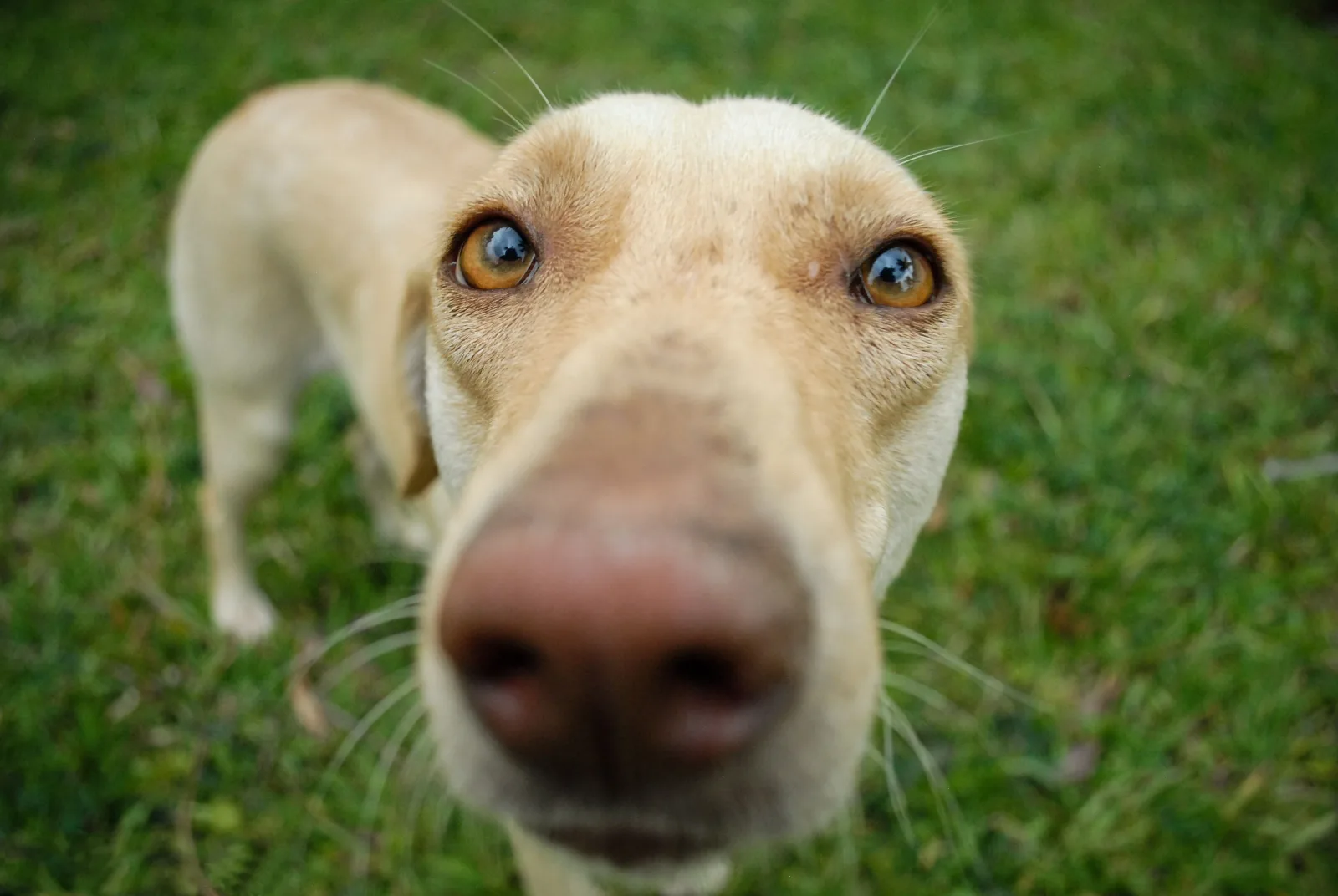
Dogs have up to 300 million scent receptors - humans have just 5 to 6 million. A dog's nose runs two channels at once: one for breathing, one purely for analysing scent, which is why dogs can sniff almost continuously, even while exhaling. The brain region that processes smell is proportionally dozens of times larger in dogs than in humans. That is why a walk full of sniffing tires a dog out mentally more than the walk itself - and why it is worth giving them the time to do it.
Your dog stops every twenty metres, pulls a long breath in through the nose and stands there longer than you would like. They are not stalling - they are working. What feels to you like a pause in the walk is, to your dog, reading a message left by every dog that passed through before. A dog's sense of smell is the most underrated part of an everyday walk - and it is worth understanding how it actually works before you tug the lead next time.
How much dog is packed into that nose
The numbers are striking. Humans have 5 to 6 million scent receptors in the nose. Dogs have anywhere from 125 million in short-nosed breeds to nearly 300 million in bloodhounds and other breeds bred for tracking. That is not a modest percentage difference - it is a different order of magnitude entirely.
But receptor count is not the whole story. The olfactory bulb - the part of the brain that processes smell - is proportionally around 40% larger in dogs relative to brain size than it is in humans. In other words, a dog does not just detect more scents; it dedicates far more brain processing power to analysing them. Researchers at the University of Alaska Fairbanks put it plainly: a dog's nose can be up to a thousand times more sensitive than a human's, and for some substances, sensitivity estimates run into the millions.
Two channels, one nose
What is less obvious is how the nose itself is built. In humans, the air we breathe and the air we smell travels down the same path. In dogs, those two functions are partially split - part of the airflow from each inhale is diverted into a side chamber where it circulates and gets analysed, then exits through side slits on the exhale instead of going straight back out the nostrils.
The practical effect: a dog can sniff almost continuously, even while breathing out, without wasting a second of contact with a scent. It is a bit like the difference between reading with one eye versus reading with two at once, only applied to the sense of smell.
The nose knows more than it lets on
The wet surface of a dog's nose is not incidental - it helps trap and dissolve airborne scent molecules before they enter the nasal cavity. Dogs periodically lick that moisture off, carrying scent particles to the vomeronasal organ on the roof of the mouth - an extra scent-and-taste organ humans simply do not have. This is partly why dogs can tell apart smells that are practically identical to us, like two people with very similar body odour.
Dog nostrils have one more trick: each side can work almost independently, letting a dog work out which direction a smell is coming from, the same way humans use two ears to locate a sound.
A nose that works in medicine
A dog's scent abilities reach far beyond a walk. Dogs trained to detect disease can pick up changes in the chemical makeup of breath and sweat that no currently available device catches as quickly or as cheaply. In one widely cited study, trained dogs identified lung cancer in breath samples with sensitivity and specificity around 99%, and breast cancer with 88% sensitivity. Results in real-world, large-scale screening tend to run lower than in controlled lab conditions, which is why dogs are treated today as a complement to standard diagnostics, not a replacement for them.
A similar mechanism is behind dogs trained to detect a drop in blood sugar in people with diabetes. Researchers found that hypoglycemia raises the concentration of isoprene, a volatile compound, in a person's breath - and a dog's nose can pick that up well before the person notices any symptoms themselves. Accuracy varies with training and conditions, but the underlying mechanism - detecting a health change by smell before it becomes visible - shows just how precise this sense really is.
A dog that can smell your stress
The idea that a dog "senses" when you are anxious is not just a sentimental owner's belief. A study from the University of Bristol found that dogs can tell the difference between the smell of a resting person's sweat and breath and the same person's smell during acute psychological stress, with accuracy reaching nearly 94%. This is likely driven by changes in cortisol levels and other volatile organic compounds that appear in human sweat and breath under tension.
What is more, the smell of human stress appears to affect a dog's own behaviour - in one study, dogs exposed to the scent of a stressed person were less likely to take a risky choice in a simple behavioural test, suggesting our stress can genuinely transfer to a dog through smell alone, before we say or do anything at all.
Why dogs sniff harder after rain
If you have noticed your dog is especially focused on sniffing on damp, overcast days, that is not a coincidence. Scent molecules travel and linger in the air differently depending on the weather. Moisture in the air and in the ground helps hold scent particles close to the surface, making them easier to pick up. A hot, dry day with strong wind quickly scatters and dries out scent trails, making scent work harder - which is why professional tracking dogs tend to perform best early in the morning or after rainfall, not in the middle of a hot afternoon.
That is a practical tip for an ordinary walk too: if you want to give your dog an especially scent-rich outing, a damp morning after overnight rain is about as good as it gets.
Why this matters on an ordinary walk
Understanding how a dog's nose works changes how you look at an everyday walk. When your dog stops at a lamp post for thirty seconds, they are not wasting time - they are reading who passed through, when, and in what state. Scent work is a form of mental effort for a dog, comparable to solving a puzzle. A few minutes of free sniffing can tire a dog out mentally more than a fast, disciplined march down the same route without a single stop.
In practice, that means one simple habit shift: instead of pulling your dog along at every pause, give them a moment. A walk where a dog can sniff freely wears them out - in the good sense - more than a longer distance covered at a forced pace. For more concrete ways to add scent work to a walk, see our guide on making dog walks better.
What this means for you as an owner
Smell is the main channel through which a dog experiences the world - ahead of sight or hearing. Once you understand that, it is easier to accept that a dog who stops at every bush is not "difficult" or "distracted." They are simply doing exactly what evolution built them to do best.
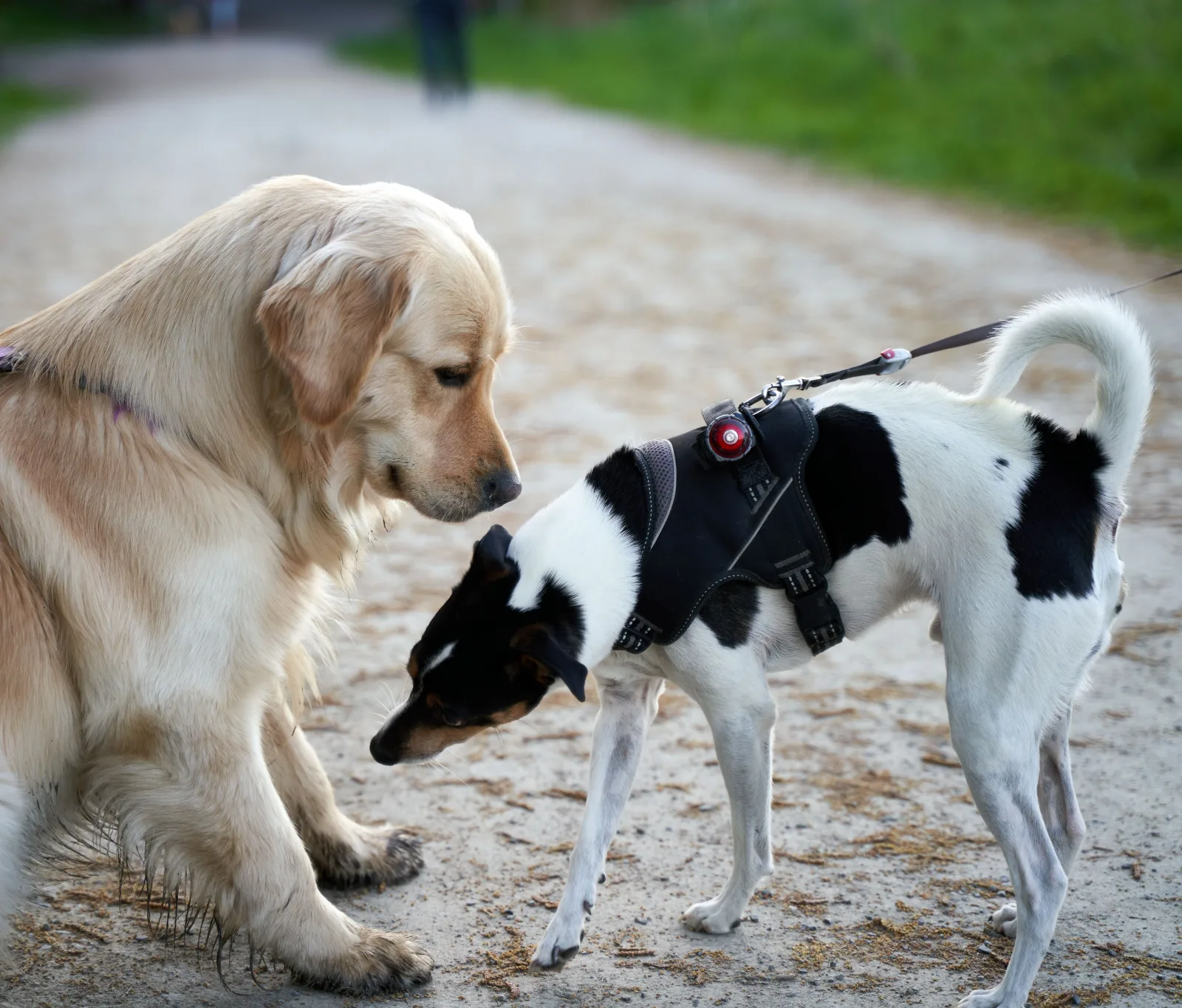
It is also worth remembering that scent is how dogs get to know each other - and every other dog in your neighbourhood is sniffing just as intently as yours. If you want to give your dog more chances for a scent-rich walk in good company, check the DOGOUT map - you will find nearby spots and owners to explore new, scent-rich routes with, well beyond your usual loop around the block.
Frequently asked questions
- How many scent receptors does a dog have?
- Anywhere from around 125 million to nearly 300 million in scent-hound breeds like bloodhounds, depending on the breed. Humans have only 5 to 6 million. That is not a small gap - it is a different order of magnitude of perception.
- Is a dog's sense of smell really that much better than a human's?
- Yes, and the scale is hard to overstate. Researchers estimate a dog's nose can be tens of thousands of times, and for some substances even millions of times, more sensitive than a human nose, depending on the compound and the breed.
- Why is a dog's nose wet?
- The moisture on a dog's nose helps trap and dissolve scent molecules from the air, boosting sensitivity. Dogs also lick that moisture off, carrying scent particles to the vomeronasal organ on the roof of the mouth - an extra scent-analysis channel humans simply do not have.
- Do all breeds smell equally well?
- No. Breeds bred for tracking - bloodhounds, beagles, many herding breeds - tend to have more scent receptors and longer noses with more olfactory surface area. Flat-faced breeds like pugs and bulldogs have a weaker sense of smell than the average dog, though still far beyond human capability.
- How can I use this on a walk?
- Let your dog sniff freely instead of pulling them along at a steady pace on the same route. A few minutes of free sniffing can tire a dog out mentally more than a hard run - it is the simplest way to enrich a daily walk without any extra gear.